Friday, August 13, 2010

Gyeongju

Daereungwon Royal Tombs
This verdant complex of 23 royal tombs, including the resting place of King Michu, is located in downtown Gyeongju—believe it or not, there are office towers on the other side of the street in the pictures below. In accordance with Korean tradition, the tombs are covered by large, grassy mounds that, at least from the outside, resemble small hills (kind of like environmentally friendly Pyramids). During excavations, archaeologists discovered tens of thousands of ornate relics and gold accessories buried with Silla monarchs. Hwangnamdaechong Tomb, for instance, contained over 30,000 pieces, including crowns, paintings and other cultural treasures.


Cheomseongdae Observatory
Constructed during the reign of Queen Seondeok, Cheomseongdae is the oldest observatory in East Asia and one of the earliest existing scientific installations in the world.


Bulguksa
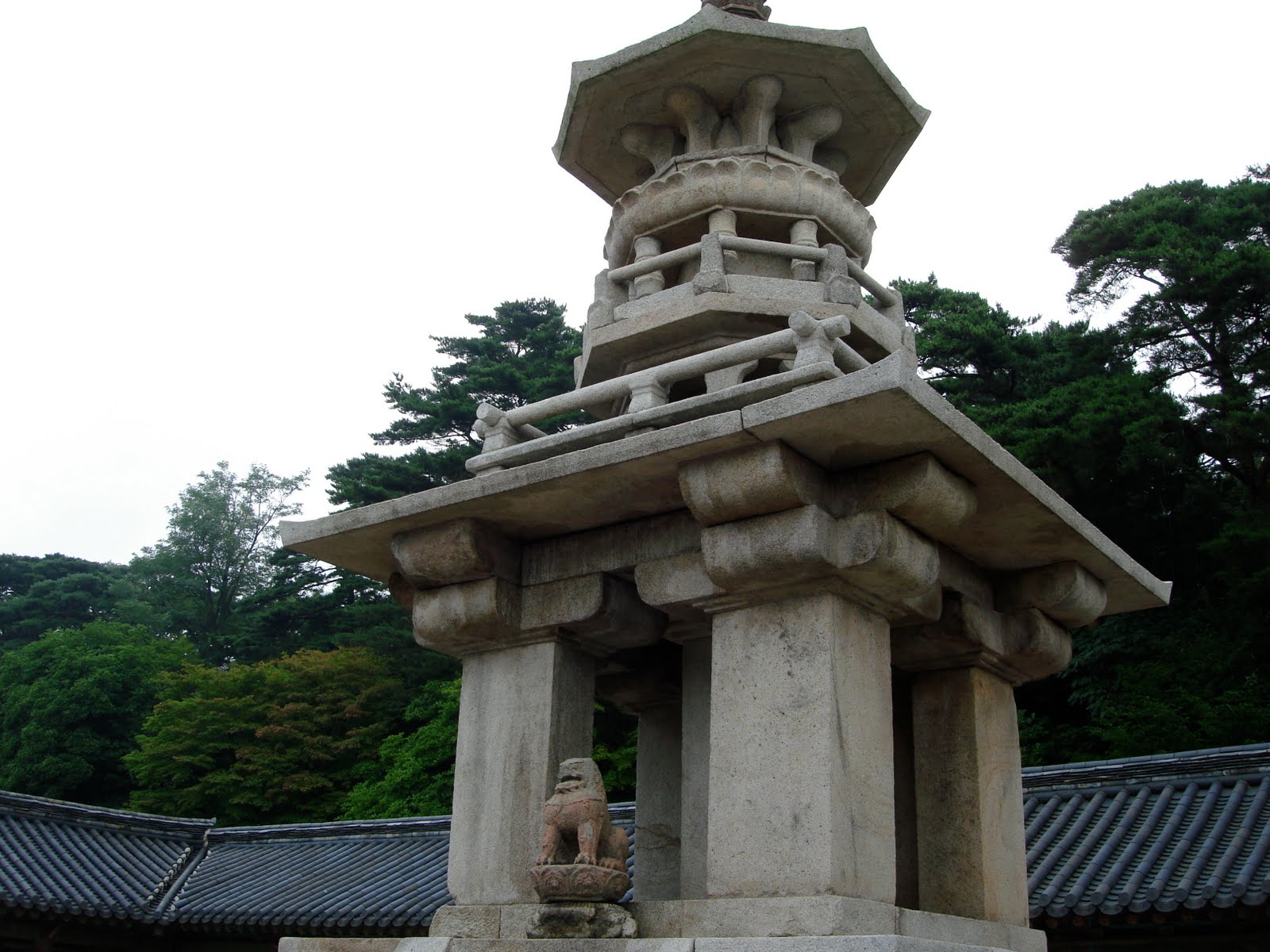
Bulguksa Temple, constructed during Korea's golden age of Buddhism, was commissioned by Prime Minister Gim Daeseong in 751 and took 23 years to complete. In addition to the main structures and Buddha statues, the stone pagodas Dabotap and Seokgatap are particularly important. Bulguksa Temple was inscribed onto the UNESCO World Heritage List in 1995 for being "a complex of exceptional significance" and "an outstanding example of the religious architecture of the region."

FISH

Seokguram Grotto
Seokguram Grotto is considered an architectural and scientific masterpiece representing the peak of Silla-era art and was added to the World Heritage List in 1995 together with Bulguksa Temple. The inscription reads, "Established in the 8th century on the slopes of Mount Toham, Seokguram Grotto contains a monumental statue of the Buddha looking at the sea in the bhumisparsha mudra position. With the surrounding portrayals of gods, Bodhisattvas and disciples, all realistically and delicately sculpted in high and low relief, it is considered a masterpiece of Buddhist art in the Far East." I've also included below pictures of the adjacent belfry (they let you ring the bell!) and traditional Buddhist prayer lanterns—colorful ones for the living, white for those who have passed away.

History of Silla

After visiting Hahoe, we headed south to Gyeongju, the capital of the ancient kingdom of Silla (57 BC - 935 AD).

Silla evolved from the city-state of Saroguk, a member of the Jinhan Confederacy during the Proto-Three Kingdoms period of Korea. The Silla monarchy was officially established in 57 BC by King Bak Hyeokgyeose near present-day Gyeongju. Throughout the Three Kingdoms of Korea era (57 BC - 668 AD), Silla coexisted with rivals Baekje to the west and Goguryeo to the north. Silla later defeated and absorbed Baekje and Goguryeo, reunifying the peninsula and ushering in the Unified Silla era of Korean history, which lasted until the founding of the Goryeo dynasty in 935.

During its millennium-long rule—Silla was one of the longest sustained dynasties in world history—the kingdom witnessed a golden age of Korean science and culture. Exquisite statues, temples, academies, pagodas, weapons and ornaments from this period remain among the most representative treasures of traditional Korean art and architecture. Many of these pieces were inspired by Buddhism, which was imported from India and formally adopted as the state religion by King Beopheung in 527.

As the capital of this prosperous kingdom, Gyeongju was at the center of Korean commerce, politics and culture for several centuries; today, a vast number of archaeological sites and cultural properties from this period are concentrated in the city. Despite damage inflicted upon valuable relics by Mongol forces, Japanese invaders and Joseon-era Neo-Confucian radicals, most of the cultural resources remain remarkably well-preserved. Therefore, despite its diminished political influence today, Gyeongju is now one of Asia's most popular and historically significant tourist destinations.

Hahoe Village

The first stop on our trip to North Gyeongsang Province was Hahoe Village, located in the town of Andong (안동하회마을). Our interest in visiting the village was piqued by Hahoe's recent UNESCO World Heritage Site designation.

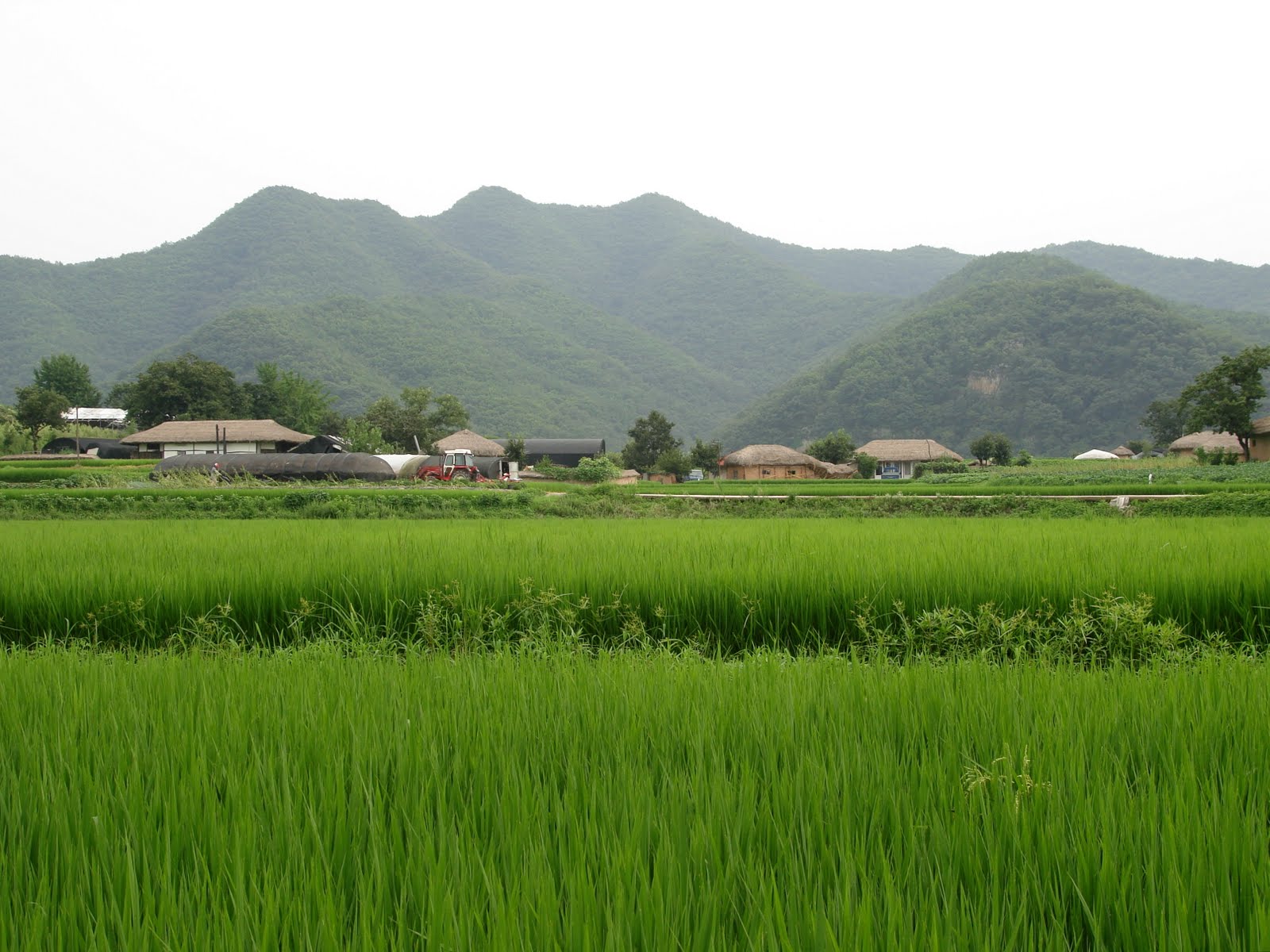
Hahoe was founded in the 16th century by the Ryu (류) clan of Pungsan and remains one of Korea's most representative clan villages. Isolated among the eastern mountains of Gyeongsang Province, Hahoe has preserved centuries-old traditions and the distinctive Confucian culture of the early Joseon Dynasty that reflects Andong's aristocratic yangban roots. A majority of the residences are still inhabited by Pungsan Ryu descendants, making the village an authentic, living, open-air museum.

Rice paddies on the outskirts of the village

Huge pond of lotus flowers near the village entrance

Path leading to the village center

Traditional residence

One of the village's two seowon (private Joseon-era academies)

Front gate of the seowon

Poem inscribed on a stone outside

Oldest tree in the village (surrounded by thousands of handwritten prayers)

Giwa tile roofs for aristocrats' residences; thatched roofs for servants' quarters

Yangjindang (the pen name of Ryu Yeong) is the oldest existing house in Hahoe Village.

Chunghyodang was built for a prominent Joseon government official after his retirement.

Enough firewood?

Mailbox

In the background, clay jars of doenjang and soy sauce

Ferry on the Nakdong River

Residences on the other side of the Nakdong

Andong's famous high-quality soju.

Andong is also famous for its traditional wooden masks.

Scarecrows

Pine forest on the eastern edge of the village

To the north, Buyongdae Cliff

Korean fir tree planted by Queen Elizabeth II during her visit to Hahoe in 1999.

Hahoe's UNESCO World Heritage Site designation seems well-deserved—I would definitely recommend Hahoe Village to tourists in Korea as a weekend trip destination (especially compared to the relatively Disneyland-esque Korean "folk village" in Yongin).

휴게소

The Korean term hyugeso (휴게소) translates to "rest stop" or "resting place," but calling a hyugeso a rest stop would be like calling Changdeokgung Palace a house. Situated every 20 kilometers along Korean freeways, these complexes offer the basics, such as gas and snacks, but also include cafeterias, parks, reading rooms, business centers, wireless internet and more. Below, a few pictures:

Information center

Site map

Life would be better if college textbooks had more pictures.

One of four coffee shops at this particular hyugeso

Random memorial/park/playground

You know, just in case you need to visit a batting cage while driving along the highway.

This country takes recycling very, very seriously.

Korean Geography

Just got back from an impromptu road trip to North Gyeongsang Province (Gyeongsangbuk-do) with Mother and Grandmother. I'll write about the trip in the next couple posts.

This was the first time I've ever been on a highway in the Korean countryside. I was struck by 1) how well-organized the highway system is and 2) how mountainous the terrain is. I should have expected the mountains: I still remember running my finger along the ridges of Korea on the big globe in the library during elementary school and wondering about the geography of the peninsula.

Indeed, Korea is crisscrossed by mountain ranges, which cover over 70 percent of the country. (In comparison, Switzerland and Colorado are approximately 65 and 60 percent mountains, respectively.) For this reason, early European visitors to Korea remarked that the terrain resembled "a sea in heavy gale." Other terms used to describe the country included Cheonggu (청구, "Land of Blue Hills") and Geumsugangsan (금수강산, "Land of Embroidered Rivers and Mountains").

Below are some pictures that I took from the car between Seoul and Gyeongju. Mountains, tunnels, rice paddies, speeding cameras and an interesting tollgate.

Monday, August 9, 2010

POSCO Center

Last week, the NGO where I'm interning visited the POSCO Center in southern Seoul, where we attended a presentation about the steelmaker's ethics management program and anti-corruption initiatives. POSCO, founded in 1968, is currently the second-largest steelmaker in the world.

Hanging in the lobby, a large sculpture by Nam June Paik
Korea's most famous mixed media artist

The highlight of the day trip was exploring the Eureka Zone on the fourth floor of the tower. Designed to enhance POSCO employees' concentration and creativity, the zone includes napping rooms, Wii stations, a miniature forest, artificial stream, massage chairs, art studios, conference tables and a library. I actually walked past four employees running through a Brahms quartet during their lunch break. In order to eliminate the fear of appearing lazy by being seen in the Eureka Zone rather than at one's desk, the company implemented a policy that requires employees to visit the fourth floor at least once a month.

New career aspiration, perhaps?

Sunday, August 8, 2010

Pulitzer Prize Photographs

This afternoon, Mia 덕분에, Oliver, Young-In, she and I headed to a photo exhibition at the Seoul Arts Center (예술의 전당), an arts complex in southern Seoul. This summer, the museum is displaying a comprehensive collection of Pulitzer Prize-winning photographs titled "Capture the Moment." The traveling exhibition, curated by Cyma Rubin of the Pulitzer Prize Board, has grown throughout the years and is in Seoul again for the 60th anniversary of the Korean War.

The photographs begins in 1942, when the prize was awarded, and takes viewers through a moving journey through the decades and around the world from labor riots ("Ford Strikers Riot", Milton Brooks 1942 award) to the Vietnam War ("The Terror of War", Nick Ut 1973) to Kosovo ("Kosovo's Sorrow", Carol Guzy 2000) to September 11 ("U.S. Attacked", Steve Ludlum 2002).

A favorite of mine is "Endurance" (James Hill), the 2002 Feature Photography winner. The beautifully haunting picture is part of a New York Times staff series "chronicling the pain and the perseverance of people enduring protracted conflict in Afghanistan and Pakistan."

Another iconic photograph on display is the iconic "Faith and Confidence" (William Beall), which won the Pulitzer in 1958 for its depiction of a moment of childhood innocence frozen in time. The photo is of a police officer patiently persuading an inquisitive two-year-old to step out of the chaos of a street parade.


(Photo credit: Sangmi)

"Capture the Moment" is on display at the Hangaram Design Museum of the Seoul Arts Center through August 29. I'd definitely recommend it to anyone in Seoul. (N.B. The line was very long on Sunday afternoon; if possible, try to make it in the morning and/or on a weekday.)

QOTD:
"If it makes you laugh, if it makes you cry, if it rips out your heart, that's a good picture."
- Eddie Adams, Pulitzer Prize-winning photojournalist

Saturday, August 7, 2010

Yongsan Electronics Market

I'm not a big gadget geek. Sure, I think it's great that I can stamp lime-green digital snowflakes onto photos on my digital camera, and I usually listen to music on my iPod when I go to the gym (which, by the way, has happened a grand total of zero times during my stay in Korea), and I am sometimes a tad jealous that Seoulites are able to watch live streaming high-quality videos on their phones-that-do-just-about-everything-except-make-breakfast-but-you-can-order-that-online while zooming through the subway. But I don't watch Steve Jobs's presentations with bated breath, and computer hardware descriptions are largely meaningless for me. I can never remember the difference between a megabyte and a gigabyte.

So it was not with eager anticipation but rather out of necessity that I begrudgingly headed to Yongsan Electronics Market a few days ago; despite the hype, Yongsan wasn't even on the list of the top 30 places I want to visit this summer in Seoul, not to mention the rest of the country. But I had misplaced the charger for my electronic razor, and in a fierce battle between sloth and stubble, stubble was emerging as the undisputed victor. And thus, armed with a sense of urgency, my razor and a wallet of Sejongs*, I hopped on the metro and made my way to Yongsan Electronics Market, hoping to order a new charger there.

I would have considered myself lucky to even be able to place an order for a new charger because my razor is at least four years old—it has been in a closet drawer for nearly its entire lifetime—and I wasn't sure how many vendors in a market famous for its computers and DVD players and cell phones would be selling outdated razor chargers.

I had severely underestimated the size and breadth of Yongsan Electronics Market. I expected a single tower or perhaps a large covered area of electronics vendors. To my amazement, I discovered that Yongsan Electronics Market comprises 20 buildings housing over 5,000 stores that sell appliances, stereos, computers, office equipment, telephones, lighting equipment, software and videos.

I'm not sure how to fully describe market—imagine every Best Buy in Texas combined with every Apple store in California stacked into 20 towers in a single neighborhood. And more. Nearly every conceivable item that has anything to do with electric charge seemed to be for sale.

As soon as I walked into one of the buildings, a helpful worker spotted the razor in my hand and whisked me to an entire floor devoted to electronic razors. Within a minute, a middle-aged man had found a matching charger and was explaining the improvements in the newer models of the particular razor. His assistant, meanwhile, cleaned the blade for me.

Mission accomplished.

*The front face of the Korean ₩10,000 bill features a portrait of Sejong the Great (r. 1418-1450), the fourth king of the Joseon Dynasty.

Yongsan Metro Station

Yongsan Station is also one of the terminals of KTX, Korea's high-speed rail system.

Electronics Land and the Terminal Electronics Shopping Center

Thursday, August 5, 2010

Sarkozy vs. Merkel

I never expected to read about cognitive dissonance in The Economist, but below are excerpts from a recent article that refers to the cognitive science term.

Incidentally, the well-written (albeit (arguably) unfairly anti-French) analysis of Berlin-Paris relations is also relevant to yesterday's post about Germany's economic recovery.

The Neighbors Fall Out - The Economist

« Diplomatic stagecraft is a fine art, complete with its own lexicon of codes and cues. To hold a “frank discussion” is to row. To “welcome the recommendations” is to drop such advice crisply into the waste-paper bin. In French diplomatic speak, the word naturellement is usually followed by an assertion that is anything but. Games of appearance are the daily routine of diplomacy. But two conflicting versions cannot both, in the long run, be true. When it comes to its dealings with Germany, France is suffering from what psychologists call cognitive dissonance.

Consider the row over economic government. The French want to concoct a euro-zone block, with a direct line to the European Central Bank and fiscal harmonisation. The Germans reject this. They insist on a wider grouping, backed by strict budgetary discipline, and harsh sanctions for bad behaviour.

Insults are being lobbed back and forth across the Rhine. The French cannot stop themselves from provoking the Germans. Mr Sarkozy claimed that the €750 billion euro-zone rescue plan was “95% French”; Pierre Lellouche, his junior Europe minister, slipped in a reference to Auschwitz when talking about the bail-out. For her part, Ms Merkel vexed the French by unilaterally banning naked short-selling, then springing an austerity plan just as the French were urging more stimulus. The pair could not even agree on whose fault it was that their meeting in Berlin last month was cancelled just a few hours before Mr Sarkozy was due to leave Paris.

French officials seem unable to accept that such differences might be serious. Yet they are. The balance of power between the two countries has shifted. Germany and France are no longer shoulder-to-shoulder equals. This is particularly hard for France. Put simply, its Europe policy has long consisted of coming up with the ideas, and getting the eager-to-please Germans to pay for them. More Europe, in other words, has meant more France. But this equation may no longer hold.

The shift is partly economic. In 1999-2009 France’s share of EU exports shrank while Germany’s grew; last year the Dutch exported more than the French. The Germans have put up with meagre pay rises and tight budgets to keep their cutting-edge industry competitive and public finances in order, whereas the French have put off serious reform and built up huge public debt, while working shorter weeks and taking more holidays. Germany sees no reason why it should be told what to do by a country that has not made much effort itself.

Another factor is a political change in Germany. As Wolfgang Proissl argues in a forthcoming paper for Bruegel, a think-tank, the euro-zone crisis has exposed the cold reality that Germany is the power in Europe that counts the most. Top brass in Brussels, or Paris, can talk as much as they like. But until Ms Merkel agrees, nothing happens. Fully 20 years after reunification, Germany is asserting its interests as the union’s chief paymaster, and no longer feels the need to please. “You can’t call it the Franco-German couple any more”, laments a French former foreign minister, “because Germany has found its place as Europe’s number one.”

Add to this combustible mix two leaders who do not understand each other, nor each other’s culture, nor even each other’s language. The steely, methodical Ms Merkel thinks that the French president lets politics triumph over rules. The mercurial, hyperactive Mr Sarkozy considers the German chancellor to be impossibly hesitant and legalistic. Germany’s federal system and culture of checks and balances deliberately brakes swift central decision-making. France’s dirigiste tradition and strong presidency means that Mr Sarkozy can do pretty much what he likes. “To make Sarkozy wait ten minutes is impossible,” sighs one Brussels official: “So he has the impression she’s slow; but she’s German.”

Picking a fight with the other may also suit, because each is in trouble at home. Ms Merkel needs to show German voters that she is not being bossed about by the French president. Mr Sarkozy, whose poll ratings have dropped to a record low, wants to prove to French voters that he still counts in Europe—and in the world, when he inherits the G20 presidency in November. It may yet be that, over narrow questions of running the euro, the pair will strike a partial bargain, just as their predecessors did. But any carefully staged reconciliation, complete with professions of granite-like unity, is bound to mask differences that will at some point emerge again. So doubt all talk of harmony, and above all beware any French declaration that begins: naturellement. »

Wirtschaft Deutschlands

In a July article, Spiegel staff announced, "The German economy has come roaring back to life this summer. The former "sick man of Europe" is back to being an engine for economic growth." The evidence:

« The country's gross domestic product increased by more than 1.5 percent in the second quarter of this year. Production in the manufacturing industry increased by 5 percent over the previous quarter. The government assessment also shows that exports grew by more than 9 percent in May. If the trend continues, say the experts, the German economy will grow by well over 2 percent this year, or almost twice as much as in most neighboring countries...Economists are proclaiming a second economic wunder. »

This New York Times article from last week explains, "Germany’s unexpectedly strong economy is generally considered good news for the rest of Europe, which depends on German demand its goods. So is the drop in joblessness, which should help increase consumer confidence and encourage Germans to take vacations in Spain and Greece and otherwise channel euros to places that need them."

Perhaps even more remarkable than the general economic recovery is the recent job growth. The NYT article notes:

« At 7.6 percent, down from 9.1 percent in January, the country’s unemployment rate has fallen almost to precrisis levels. Companies, including the electronics and engineering giant Siemens, the truck maker MAN or the carmaker Daimler, are ramping up worker hours. BMW said it was seeking 1,000 people in Germany to work in research and development as well as purchasing and sales.

Germany’s newfound status as a jobs machine stands in stark contrast to its image of only five years ago, when unemployment was above 13 percent, more than five million people were jobless, and the country was a symbol of labor market inflexibility. »

Total unemployment is expected to drop below the 2.8 million mark this fall, the lowest level since 1991.

How has Germany orchestrated this recovery?
  • Keynes certainly provided much of the inspiration: as the financial crisis became a global contagion, the German government established the €480 billion Sonderfonds Finanzmarktstabilisierung (Fund for Financial Market Stabilization), which comprises guarantees and capitalization assistance for troubled banks. The next month, the government began to implement part of its €80 billion stimulus package, and in January 2009, Berlin unveiled an €115 billion Wirtschaftsfonds Deutschland, which extended loans to companies suffering from the financial crisis.
  • According to the Spiegel, "the second large-scale program that the government devised to assist companies, [the Kurzarbeit] short-time working program, also helped bridge the economic slump. The legal framework for the program has existed in German social legislation for decades. When companies experience sharp declines in sales, they are permitted to reduce their employees' working hours, and the government offsets a portion of the costs. The goal is to avoid layoffs and retain employees until the recession is over. In the most recent crisis, Berlin repeatedly enhanced the rule...While the jobless count grew by seven million in the United States, Germany experienced only a slight increase. In return, however, the number of short-time workers rose sharply, until it reached a record 1.5 million last May...Now that the economy is picking up steam once again, Germany industry already has a large reserve of well-trained employees at its disposal to handle the growth in orders, and at minimal cost." Klaus Zimmermann, president of the German Institute for Economic Research, called short work “the most important stimulus program.” “You couldn’t generate exports; you couldn’t make the U.S. buy German products,” Mr. Zimmermann said. “You could support the work force.”

The stimulus programs, while being praised for their evident effectiveness, are simultaneously being criticized for their shortcomings. For instance, the €5 billion automobile scrapping premium—a program similar to "Cash for Clunkers" in the U.S.—has primarily benefited foreign small car manufacturers, such as Dacia, Fiat, Suzuki and Kia, excluding German luxury carmakers Audi, BMW, Mercedes-Benz and Porsche got nothing. "We are the only country," Daimler CEO Dieter Zetsche scoffed, "that has created a program worth billions to subsidize foreign industry."

The Spiegel criticizes other questionable applications of stimulus funds, ranging from the €7.5 million renovation of a government-owned Arabian horse-breeding farm in the southwestern town of Marbach and a €15 million interactive museum for old hunting weapons in the northern state of Lower Saxony to €7.5 Arctic Sea habitat at the Hamburg Zoo that will house polar bears and common murres. The article continues, "The government kept moribund banks alive and rescued companies that didn't need rescuing. It spent money to allow companies to scale back production and paid consumers premiums to destroy assets with intrinsic value. Streets were repaved only to be torn up again soon afterwards, and schools were renovated and later shut down."

Additionally, despite the current economic growth, there is still uncertainty about the future, albeit much more confidence than in Germany's neighbors. The NYT comments, "Amid all the celebrating in German boardrooms, there is also nervousness about how long demand in Asia can continue to compensate for slower growth in Europe." Complicating Berlin's view of Asia as an important export market is competition with Asian manufacturers. Notably, a sharp decline in German exports caused Germany to lose the title of global export leader to China last year (Germany's powerhouse economy had led the world in exports since 2003, when it surpassed the United States.)

Nonetheless, it appears that the German government's timely decisions have helped prevent the global recession from taking a greater toll on the German economy, which will doubtlessly be key for future pan-European recovery.

Wednesday, August 4, 2010

Illy Iced Green Tea Latte

근데 혼자 사 마시니까 훨씬 덜 맛있네...ㅎㅎ

Monday, August 2, 2010

World Heritage Sites: Hahoe and Yangdong

Two historic Korean villages have been newly designated as World Heritage Sites during the UNESCO World Heritage Committee's 34th convention in Brasilia. Under the collective name "Historic Villages of Korea: Hahoe and Yangdong," these traditional villages in North Gyeongsang Province have become the nation's 10th UNESCO-registered treasures.

Hahoe and Yangdong reflect “the distinctive aristocratic Confucian culture” of the Joseon Dynasty, the Committee said on UNESCO’s website. The website also reads, "The landscapes of mountains, trees and water around the villages, framed in views from pavilions and retreats, were celebrated for their beauty by 17th and 18th century poets."

Here's a photograph from the Chosun Ilbo and more information in English from the JoongAng Daily.

Hopefully I'll have a chance to visit at least one of the villages before heading back to the States.

Dear K&C

It's Monday. And I'm not in a suit. No tie. No card key in my pocket, Northgate 3F meetings, ₩2000 bottle of 찬물녹차, awkward Konglish when the phone rings, Lexis, fruit smoothies, time sheets, or my first open door policy since upper year (well, unless IS counts).

What a month. What people.


뗑큐베리감사.